Dehumidifier Size Calculator: Find the Right Pint Capacity for Your Room
Use this dehumidifier sizing calculator to determine the pint capacity (pints per day) you need. Enter your room dimensions, dampness level, temperature, and moisture sources to get a precise recommendation — avoiding a unit that is too weak to dry the air or oversized for your space.
Best Dehumidifier for You:
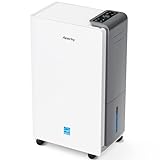


Why Dehumidifier Sizing Matters: A Complete Guide to Pint Capacity, Temperature, and Moisture Control
A dehumidifier is only effective if it can remove moisture from the air faster than it accumulates. An undersized unit will run continuously, never reaching the target humidity, and may leave you with a musty smell, condensation on windows, mold growth, and a clammy, uncomfortable feeling. An oversized unit will cycle on and off too frequently, waste energy, and may not run long enough to remove moisture effectively. This calculator helps you find the right dehumidifier size by estimating the pint capacity (pints per day) needed to dry your space, while accounting for room volume, dampness level, temperature, moisture sources, and how airtight your home is.
The Key Measurement: Pints per Day
Dehumidifier size is defined by its moisture removal capacity, expressed in pints per day (PPD). This is the amount of water the unit can remove from the air in 24 hours under standard test conditions (80°F and 60% relative humidity). Common residential capacities range from 20–30 pints per day for small, moderately damp rooms to 50–70 pints per day for basements and very damp spaces, and 70–100+ pints per day for commercial or extreme conditions. When shopping, always look at the pint capacity at the temperature and humidity you expect. A unit rated at 50 pints per day at 80°F may only remove 30 pints per day at 60°F — a critical difference in cool basements. This calculator estimates the required capacity based on your room and conditions, and recommends a practical pint class.
The Fundamental Formula: Room Volume × Dampness × Temperature × Moisture Sources
The core calculation estimates how much water must be removed from the air to reach a comfortable humidity level, accounting for the fact that your home continuously gains moisture from the outdoors, from occupants, and from indoor activities. The formula is:
Required Pints/Day ≈ Room Volume (cubic feet) ÷ 1,000 × Base Factor × Dampness × Temperature × Moisture Sources × Airtightness × Room Type
The base factor is derived from industry guidelines: a 1,000-cubic-foot space with moderate dampness and moderate temperature needs roughly 10–12 pints per day. For example, a 12 ft × 15 ft bedroom with an 8-ft ceiling has a volume of 1,440 cubic feet. At moderate dampness, moderate temperature, high moisture sources, average airtightness, and standard room type, the required capacity is roughly 20–25 pints per day. This calculator automates this formula and rounds the result to a practical pint class.
How the Calculator Estimates Your Dehumidifier Size
The calculator follows a transparent, repeatable formula:
| Factor | How It Is Applied | Typical Impact |
|---|---|---|
| Room volume | Length × Width × Ceiling Height | Sets the base moisture load |
| Dampness level | Multiplier from 1.0 to 2.0 | Doubles required capacity from damp to extremely wet |
| Temperature | Multiplier from 1.0 to 1.5 | +50% for cold rooms (need desiccant units) |
| Moisture sources | Multiplier from 1.0 to 1.5 | +50% for constant dampness or seepage |
| Airtightness | Multiplier from 0.9 to 1.15 | +15% for leaky homes |
| Room type | Multiplier from 1.0 to 1.2 | +20% for basements and crawlspaces |
After applying these factors, the calculator determines the required capacity in pints per day, rounds it to the nearest 5 pints, and suggests a practical dehumidifier class (small, medium, large, extra-large). It also provides advice on compressor vs. desiccant technology based on room temperature, and a tank capacity recommendation.
Why Pint Capacity at Your Temperature Matters
Dehumidifier pint ratings are measured at 80°F and 60% relative humidity — conditions that rarely match a cool basement or a winter bedroom. Compressor-based dehumidifiers lose capacity as temperature drops: a 50-pint unit at 80°F may only remove 30 pints at 60°F and just 15–20 pints at 50°F. This is why the calculator asks for room temperature and adjusts the required capacity upward for cool rooms. If your space is below 60°F, a compressor dehumidifier may struggle or freeze up. In that case, a desiccant dehumidifier is the better choice: it uses a rotating wheel of desiccant material and works effectively at low temperatures, though it uses more energy and produces warmer exhaust air. For cold basements, garages, and crawlspaces, always choose a desiccant unit or a compressor unit specifically rated for low-temperature operation.
| Room Size (sq ft, 8 ft ceiling) | Damp (pints/day) | Very Damp (pints/day) | Wet (pints/day) | Typical Use Case |
|---|---|---|---|---|
| Up to 150 | 10–15 | 15–20 | 20–30 | Small bedroom, bathroom, closet |
| 150–250 | 15–20 | 20–30 | 30–40 | Bedroom, small living room |
| 250–350 | 20–30 | 30–40 | 40–50 | Master bedroom, studio |
| 350–450 | 30–40 | 40–50 | 50–60 | Living room, open office |
| 450–550 | 40–50 | 50–60 | 60–70 | Large living room, loft |
| 550–700 | 50–60 | 60–70 | 70–100+ | Basement, crawlspace, commercial |
Compressor vs. Desiccant: Which Technology Do You Need?
Dehumidifiers come in two main types, each with different temperature ranges and sizing implications. Compressor (refrigerant) dehumidifiers work like a refrigerator: they cool the air to condense moisture, then reheat it. They are the most common and most energy-efficient type in warm conditions (above 65°F). However, their capacity drops significantly as temperature falls, and they may freeze up below 60°F. Desiccant dehumidifiers use a rotating wheel of moisture-absorbing material (silica gel or zeolite) to capture moisture, then heat the wheel to release the moisture outside. They work effectively at low temperatures (down to 40°F or lower) and are lighter and quieter than compressor units, but they use more energy and produce warmer exhaust air. For a warm, damp basement, a compressor unit is the best choice. For a cold basement, garage, or crawlspace, choose a desiccant unit. The calculator recommends the appropriate type based on your temperature input.
Placement and Airflow: Where You Put the Dehumidifier Matters
Even a perfectly sized dehumidifier will underperform if it is placed in a corner behind furniture or in a spot with poor airflow. Dehumidifiers need to draw in room air and distribute dry air throughout the space. Place the dehumidifier at least 6–12 inches away from walls, furniture, and curtains. Ideally, position it in the center of the room or in the dampest area, with its air output directed toward the center of the space. For basements, place the unit near the moisture source (e.g., a seepage wall or a crawlspace opening) but not directly against it. For bedrooms and living rooms, place the unit near the door or in a central location so dry air can circulate. Avoid placing a dehumidifier in a closet, behind a door, or under a desk — these locations block airflow and reduce effectiveness. If you have a large or open-plan space, consider two smaller dehumidifiers placed in different areas rather than one large unit in a single spot. Also, keep the dehumidifier away from return vents, which can pull dry air out of the room before it circulates.
Target Humidity: Why 40–50% Is the Sweet Spot
Most health experts recommend keeping indoor humidity between 40% and 50%. Above 50%, you risk condensation on windows, mold growth, dust mites, and a clammy feeling. Above 60%, mold and bacteria thrive. Below 40%, you may experience dry skin, chapped lips, dry eyes, and static shocks. The calculator does not ask for a target humidity because dehumidifier sizing is primarily driven by the dampness level and room conditions; the goal is to bring the space into the 40–50% range. Use a hygrometer (available for $10–$20) to monitor your actual humidity and adjust your dehumidifier accordingly. Most dehumidifiers have a built-in humidistat that lets you set a target humidity and will cycle on and off to maintain it. Do not rely on the dehumidifier's built-in hygrometer alone, which is often inaccurate; verify with a separate hygrometer.
Maintenance and Water Removal
Dehumidifiers require regular maintenance to operate efficiently. Empty the tank frequently — a 50-pint unit can fill a 2-gallon tank in a day or less in very damp conditions. Most units have a tank-full indicator and auto-shutoff. For continuous operation, look for a unit with a drain hose connection or a built-in condensate pump. A gravity drain hose is the simplest option: run it to a floor drain, sump pit, or outside. A condensate pump lets you push water upward to a sink or window, which is useful in basements without a floor drain. Clean the air filter every 1–2 weeks (or more often in dusty environments) by rinsing it with warm water and letting it dry completely. Clean the coils and fan annually with a soft brush or vacuum. If you notice a musty smell, clean the unit thoroughly and check for mold growth. For desiccant units, follow the manufacturer's instructions for cleaning or replacing the desiccant wheel.
Energy Efficiency and Operating Cost
Dehumidifiers use more energy than most other home appliances because they run continuously in damp conditions. A 50-pint compressor dehumidifier typically draws 500–700 watts; a desiccant unit may draw 600–900 watts. Running a 600-watt unit 24/7 for 90 days at $0.15/kWh costs about $190. To reduce operating costs, choose an ENERGY STAR certified unit, which uses about 15–30% less energy than standard models. Look for a unit with an adjustable humidistat and run it only when needed — most dehumidifiers do not need to run 24/7 once the space is dry. In cool conditions, use a desiccant unit only when necessary, since it uses more energy. Also consider the heat output: compressor dehumidifiers release warm, dry air, which can be beneficial in cool basements but may make warm rooms uncomfortable. Desiccant units release warmer air than compressor units, which can be a drawback in already-warm spaces.
Real-World Examples and Sanity Checks
Consider a 12 ft × 15 ft bedroom (180 sq ft) with an 8-ft ceiling, very damp conditions, moderate temperature, high moisture sources, average airtightness, and standard room type. Volume = 180 × 8 = 1,440 cubic feet. Using the calculator's formula, the required capacity is roughly 20–25 pints per day. A 20- or 25-pint dehumidifier would be suitable for this bedroom. Now consider a 20 ft × 20 ft basement (400 sq ft) with an 8-ft ceiling, wet conditions, cool temperature (60°F), very high moisture sources (seepage), leaky home, and basement room type. Volume = 400 × 8 = 3,200 cubic feet. Required capacity is roughly 60–75 pints per day. A desiccant dehumidifier rated at 70 pints per day would be needed — a compressor unit would struggle at 60°F. This shows why the extra inputs matter far more than the simple "recommended room size" on the box.
Additional Factors the Calculator Cannot Capture
No online calculator can replace a professional moisture assessment, but our tool covers the dominant variables for dehumidifier selection. Still, be aware of factors that can push your real load higher or lower. Outdoor humidity: if you live in a humid climate, your indoor humidity may be higher, requiring more capacity. Foundation type: basements and crawlspaces are inherently damper than above-grade rooms. Drainage: poor exterior drainage can cause seepage, dramatically increasing moisture load. HVAC system: a central AC removes moisture in summer, reducing the need for a dehumidifier; but in shoulder seasons, the AC may not run enough to dehumidify. Ventilation: exhaust fans in kitchens and bathrooms remove moisture, reducing the need. Plumbing leaks: even a small leak can add significant moisture over time. If your situation is extreme in any of these dimensions, treat the calculator result as a minimum and size up by one class.
Frequently Asked Questions
What size dehumidifier do I need for a basement?
For a typical 400–500 square foot basement with moderate dampness, you need a 30–50 pint dehumidifier. For a very damp or wet basement (visible moisture, musty smell), you need 50–70 pints. For a basement with standing water or constant seepage, you may need 70–100+ pints, or a combination of a dehumidifier and improved drainage. Also consider temperature: below 60°F, choose a desiccant dehumidifier, which works better in cool conditions. Use the calculator above with your exact dimensions and dampness level for a precise recommendation.
Is 20 pints enough for a bedroom?
For a typical 12 ft × 15 ft bedroom (180 sq ft) with moderate dampness and moderate temperature, a 20-pint dehumidifier is usually sufficient. If the bedroom is very damp, has high moisture sources (e.g., an attached bathroom), or is in a humid climate, you may need 25–30 pints. If the bedroom is in a cool basement or has condensation on windows, size up to 30 pints or choose a desiccant unit. Use the calculator above with your specific inputs to be sure.
What is the difference between compressor and desiccant dehumidifiers?
Compressor (refrigerant) dehumidifiers cool the air to condense moisture, then reheat it. They are the most common and most energy-efficient type in warm conditions (above 65°F), but their capacity drops as temperature falls, and they may freeze up below 60°F. Desiccant dehumidifiers use a rotating wheel of moisture-absorbing material to capture moisture, then heat the wheel to release the moisture outside. They work effectively at low temperatures (down to 40°F or lower) and are lighter and quieter, but they use more energy and produce warmer exhaust air. For a warm basement, choose a compressor unit. For a cold basement or garage, choose a desiccant unit.
How many pints per day do I need for my room size?
It depends on the room volume, dampness level, temperature, moisture sources, and airtightness. A small bedroom with moderate dampness may need 15–20 pints per day, while a large basement with wet conditions may need 60–70 pints per day. As a rough guide, a 150-square-foot room needs 10–20 pints, 250 square feet needs 20–30 pints, 350 square feet needs 30–40 pints, and 500 square feet needs 40–60 pints, depending on dampness and temperature. The calculator above estimates the required capacity based on your inputs.
What is the ideal indoor humidity level?
Most health experts recommend keeping indoor humidity between 40% and 50%. Above 50%, you risk condensation on windows, mold growth, dust mites, and a clammy feeling. Above 60%, mold and bacteria thrive. Below 40%, you may experience dry skin, chapped lips, dry eyes, and static shocks. Use a hygrometer to monitor your actual humidity and adjust your dehumidifier accordingly. Most dehumidifiers have a built-in humidistat that lets you set a target humidity and will cycle on and off to maintain it.
Do I need a dehumidifier in every room?
Not necessarily. If your home has a central AC, it removes moisture in summer, so you may only need a dehumidifier in the basement or a particularly damp room. If you have a whole-house dehumidifier connected to your HVAC system, that may be enough. For single rooms, a portable dehumidifier in the basement, bathroom, or bedroom is often sufficient. Bathrooms and kitchens are usually more humid and may benefit from exhaust fans instead of a dehumidifier. If you have a large or open-plan home, you may need two or more portable dehumidifiers, or a whole-house system. Use the calculator to size each room individually.
How often should I empty the dehumidifier tank?
It depends on the unit's capacity and the moisture load. A 50-pint dehumidifier can fill a 2-gallon tank in a day or less in very damp conditions. Most units have a tank-full indicator and auto-shutoff, so you do not need to worry about overflow. For continuous operation, look for a unit with a drain hose connection or a built-in condensate pump. A gravity drain hose is the simplest option: run it to a floor drain, sump pit, or outside. A condensate pump lets you push water upward to a sink or window, which is useful in basements without a floor drain.
How often should I clean my dehumidifier?
Clean the air filter every 1–2 weeks (or more often in dusty environments) by rinsing it with warm water and letting it dry completely. Clean the coils and fan annually with a soft brush or vacuum. If you notice a musty smell, clean the unit thoroughly and check for mold growth. For desiccant units, follow the manufacturer's instructions for cleaning or replacing the desiccant wheel. Regular maintenance keeps the unit running efficiently and prevents mold and bacteria from growing inside.
Can a dehumidifier help with allergies and asthma?
Yes, maintaining indoor humidity between 40% and 50% can help with allergies and asthma by reducing dust mites, mold spores, and other allergens that thrive in humid conditions. However, too much dehumidification (below 40%) can cause dry skin and respiratory irritation. Use a dehumidifier with a humidistat and monitor humidity with a hygrometer. If you have severe allergies or asthma, consult your doctor and consider an air purifier alongside a dehumidifier.
Are dehumidifiers safe to run overnight?
Yes, most dehumidifiers are safe to run overnight, provided they have auto-shutoff when the tank is full and are placed on a stable, level surface. However, dehumidifiers can be noisy, which may disturb sleep. Look for a unit with a low-noise mode or a quieter desiccant model for bedrooms. Also, running a dehumidifier overnight in a bedroom can dry the air too much, causing dry throat or skin. Set the humidistat to 45–50% and use a hygrometer to monitor. Never place a dehumidifier near water or in a wet area where it could tip over.
Dehumidifier Sizing Checklist
- Measure room length, width, and ceiling height accurately
- Calculate room volume (length × width × height)
- Assess dampness level: damp, very damp, wet, or extremely wet
- Note room temperature — below 60°F needs a desiccant unit
- Identify moisture sources: laundry, showers, cooking, plants, seepage
- Use the calculator to get a pint-per-day target, then round to the nearest standard size
- Choose compressor for warm rooms, desiccant for cool rooms
- Look for a built-in humidistat and auto-shutoff
- Consider a drain hose or condensate pump for continuous operation
- Compare ENERGY STAR certification and wattage for efficiency
Professional Assessment vs. Calculator Estimate
Indoor air quality and moisture professionals use hygrometers, moisture meters, and blower-door tests to assess a space and recommend dehumidifier sizes. Those assessments are more accurate than any online tool, but they are also time-consuming and often overkill for a single room. Our calculator sits between the crude "recommended room size" on a box and a full professional assessment. It captures the variables that matter most for dehumidifier selection — room volume, dampness, temperature, moisture sources, and airtightness — while keeping the interface simple. If you have severe moisture problems, mold growth, or a large basement, consider consulting a moisture control specialist. For a bedroom, bathroom, or small basement, the calculator's result will serve you well.
Final Thoughts: Dry Air, Better Health
The right dehumidifier size is the one that removes moisture fast enough to keep your space dry without overshooting and wasting energy. Use this calculator as your first step, then verify the pint capacity at your expected temperature before buying. Remember that a dehumidifier is not a substitute for addressing the root causes of moisture — fixing leaks, improving drainage, and ventilating bathrooms and kitchens are all essential. But for damp basements, humid bedrooms, and moisture-prone spaces, a correctly sized dehumidifier is a reliable, effective solution. Bookmark this page, run your numbers before you buy, and enjoy a drier, healthier, more comfortable home.